
A Letter Across Four Millennia
Imagine life in southern Iraq nearly 4,000 years ago. You might expect a civilization utterly unlike our own, with unfamiliar languages, customs, and concerns. Yet in the 18th century BC, a student named Iddin-Sîn wrote to his mother, Zinû, from boarding school because he was unhappy with his clothes, jealous of what the other boys were wearing, and quite prepared to suggest that this proved she did not love him enough.
Sound familiar?
Pressed into an ancient clay tablet now housed in Paris’ Musée du Louvre are cuneiform characters that translate, in part, as:
“Tell the lady Zinû Iddin-Sîn sends the following message: May the gods Shamash, Marduk and Ilabrat keep you forever in good health for my sake. From year to year, the clothes of the young gentlemen here become better, but you let my clothes get worse from year to year. Indeed, you persisted in making my clothes poorer and more scanty. At a time when in our house wool is used up like bread, you have made me poor clothes. The son of Adad-iddinam, whose father is only an assistant of my father, has two new sets of clothes, while you fuss even about a single set of clothes for me. In spite of the fact that you bore me and his mother only adopted him, his mother loves him, while you, you do not love me!”
Here was a boy living on the other side of the world nearly 4,000 years ago, manipulating his mother by appealing to her pride and even questioning her love for him, all because a schoolmate had nicer clothes. When I learned about this letter, I was struck by the sheer humanness of it. Four thousand years suddenly did not seem like enough time to have changed very much about what occupies us from one ordinary day to the next.
I often think about the enormous technological distance between their world and ours. We live with conveniences Iddin-Sîn could scarcely have imagined. Yet for all that progress, the emotional distance between us can sometimes seem remarkably small.
Most of us are familiar with the Code of Hammurabi, written around the same time as this schoolboy’s lament. In fact, Iddin-Sîn’s father was a high-ranking official in Hammurabi’s administration, which places the family in the upper class. Legal codes, commercial transactions, major historic events, religious texts, and votive inscriptions are the kinds of records I expect to encounter from antiquity. But nothing could have prepared me for the revelation in a preserved clay tablet that a young clothes-horse from Babylon tried to shame his mother into sending him better linen garments because a peer (whose father was of lower rank!) was better dressed.
This surviving tablet, most likely dictated to a scribe given that the salutation reads, “Iddin-Sîn sends the following message,” matters precisely because it tells us what a young person cared about on an ordinary day. History records what civilizations considered important. Personal letters preserve what individuals cared about in the course of ordinary life.
Historian Stephen Bertman insightfully suggests why ancient personal writings can have such a poignent effect on us: "Curiously, in one way or another, they all treat the subject of material possession. Therein perhaps lies the secret of their potency: as we read the letters we realize that the fragile things that mattered most to the writers are, like the writers themselves, no more, even as we ourselves and the things we cherish will someday cease to exist.”
Iddin-Sîn’s clothes and other personal treasures no longer exist. But we know of them because her cared enough to record his feelings about them. That the letter exists, against the odds and across four millennia, is an absolute wonder. First, because a spoiled young man felt entitled enough to press his disappointment into wet clay, and second, because by sheer accident of preservation, the tablet outlived nearly everything and everyone around it.
It makes me think about our own reliance on technology, and the way so many of our words now live in the cloud, untethered from the material world of paper and ink. We communicate constantly, but much of what we say is stored in forms that are fragile, fleeting, or simply not meant to be kept.
I have encouraged my adult children to write letters and cards to the people they love so that decades from now, they may reread them with fondness and recover parts of their lives they might otherwise have forgotten.
If letter writing were still the norm, perhaps in 6026 a mother somewhere might unearth a note from an obnoxious kid giving his own mother a hard time for buying his clothes at the Gap instead of Kith.
Some things, it seems, really do survive the ages.
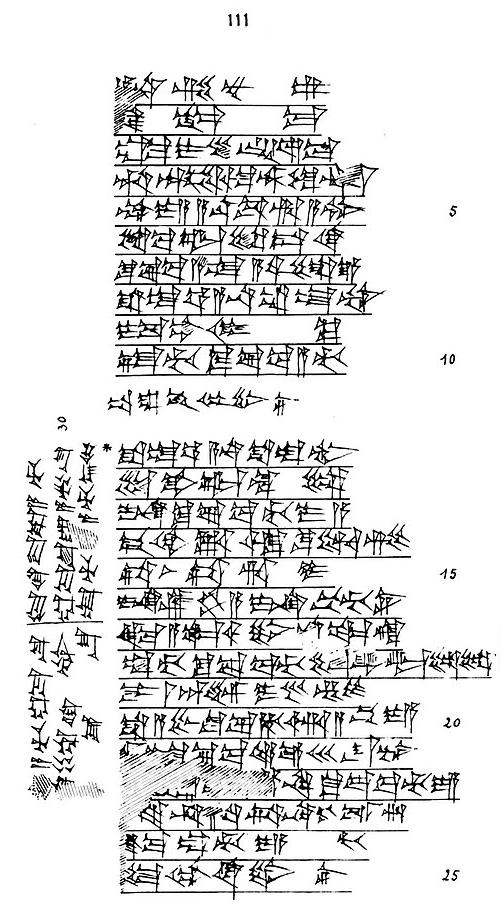
A hand copy of the Akkadian text, written in cuneiform, from Iddin-Sîn’s letter.